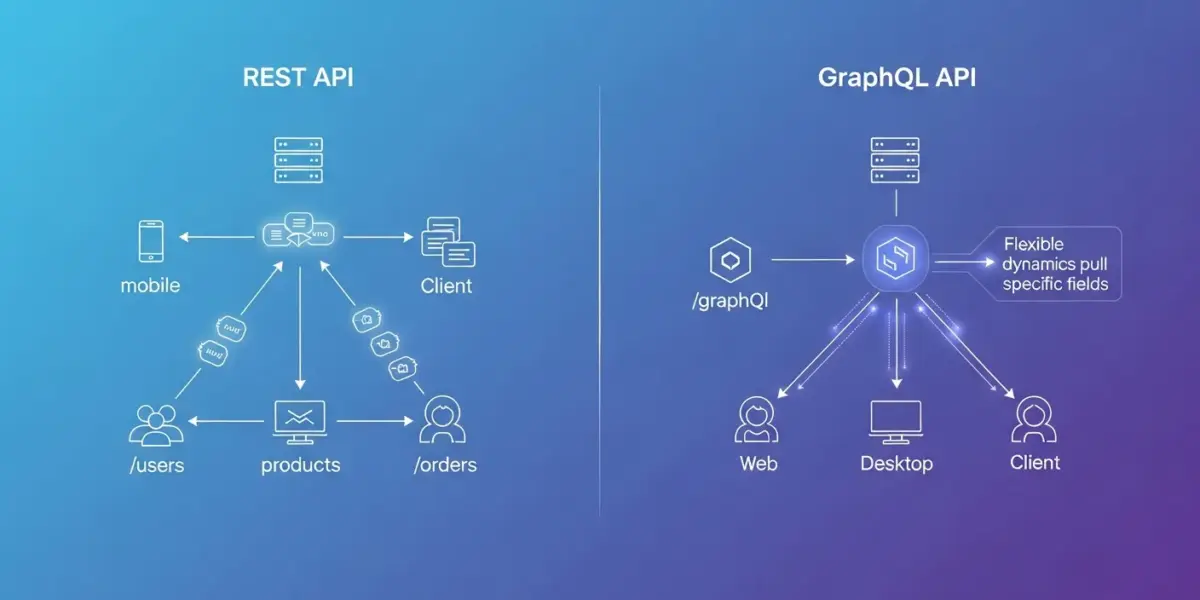
Choosing between GraphQL and REST is one of the most consequential API architecture decisions you’ll make. Both have proven track records, but they excel in different scenarios. This comprehensive comparison will help you make the right choice for your specific needs.
Understanding the Fundamental Difference
REST (Representational State Transfer) organizes APIs around resources with fixed endpoints. GraphQL provides a single endpoint where clients specify exactly what data they need. This fundamental difference cascades into how you design, build, and consume APIs.
Quick Comparison
| Aspect | REST | GraphQL |
|---|---|---|
| Endpoints | Multiple (per resource) | Single endpoint |
| Data fetching | Fixed responses | Client specifies fields |
| Over-fetching | Common problem | Eliminated |
| Under-fetching | Requires multiple calls | Single request |
| Caching | HTTP caching built-in | Requires setup |
| Learning curve | Lower | Higher |
| Tooling maturity | Very mature | Rapidly maturing |
REST API: The Established Standard
REST has been the dominant API paradigm for over 20 years. Its resource-oriented approach maps naturally to CRUD operations and HTTP methods.
REST Example: E-commerce API
# Get a product
GET /api/products/123
Response:
{
  "id": 123,
  "name": "Wireless Headphones",
  "price": 149.99,
  "description": "Premium noise-canceling headphones...",
  "categoryId": 5,
  "vendorId": 42,
  "specs": { ... },
  "reviews": [ ... ],  // 50 reviews you might not need
  "relatedProducts": [ ... ]  // 20 products you didn't ask for
}

# Get product's vendor (second request needed)
GET /api/vendors/42
Response:
{
  "id": 42,
  "name": "AudioTech Inc",
  "rating": 4.8,
  ...
}

# Get product's category (third request needed)
GET /api/categories/5
Response:
{
  "id": 5,
  "name": "Audio Equipment",
  ...
}
REST Strengths
- HTTP caching: Native browser and CDN caching via Cache-Control headers
- Simplicity: Easy to understand, implement, and debug
- Stateless: Each request contains all needed information
- Wide adoption: Universal tooling, documentation, and developer familiarity
- File uploads: Straightforward multipart/form-data support
REST Weaknesses
- Over-fetching: Endpoints return fixed data structures, often more than needed
- Under-fetching: Complex views require multiple round trips
- Versioning complexity: Breaking changes require new versions
- Documentation drift: Docs can become outdated without discipline
GraphQL: The Flexible Alternative
GraphQL, created by Facebook in 2015, gives clients complete control over the data they receive. Its type system and introspection capabilities enable powerful tooling.
GraphQL Example: Same E-commerce Data
# Single request gets exactly what you need
query GetProductDetails($id: ID!) {
  product(id: $id) {
    id
    name
    price
    vendor {
      name
      rating
    }
    category {
      name
    }
  }
}

# Response: Only requested fields, single request
{
  "data": {
    "product": {
      "id": "123",
      "name": "Wireless Headphones",
      "price": 149.99,
      "vendor": {
        "name": "AudioTech Inc",
        "rating": 4.8
      },
      "category": {
        "name": "Audio Equipment"
      }
    }
  }
}
GraphQL Strengths
- No over-fetching: Clients get exactly what they request
- No under-fetching: Related data in single request
- Strong typing: Schema defines all possible operations
- Self-documenting: Introspection enables automatic documentation
- Evolvable: Add fields without breaking existing clients
- Great developer experience: IDE autocomplete, validation
GraphQL Weaknesses
- Caching complexity: Single endpoint breaks HTTP caching
- Performance risks: Deeply nested queries can be expensive
- Learning curve: New concepts (resolvers, schema design, N+1 problems)
- File uploads: Requires additional specification (GraphQL Upload)
- Error handling: Always returns 200, errors in response body
Implementation Deep Dive
Building a REST API with Node.js
// Express REST API
import express from 'express';
import { prisma } from './db';

const app = express();

// GET /api/products/:id
app.get('/api/products/:id', async (req, res) => {
  try {
    const product = await prisma.product.findUnique({
      where: { id: parseInt(req.params.id) },
      include: {
        vendor: true,
        category: true,
        reviews: { take: 10 },  // Always fetched
      },
    });

    if (!product) {
      return res.status(404).json({ error: 'Product not found' });
    }

    res.json(product);
  } catch (error) {
    res.status(500).json({ error: 'Internal server error' });
  }
});

// GET /api/products (with pagination)
app.get('/api/products', async (req, res) => {
  const { page = 1, limit = 20, category } = req.query;

  const products = await prisma.product.findMany({
    where: category ? { categoryId: parseInt(category) } : {},
    skip: (page - 1) * limit,
    take: parseInt(limit),
    include: { vendor: true },
  });

  res.json({
    data: products,
    page: parseInt(page),
    limit: parseInt(limit),
  });
});
Building a GraphQL API
// GraphQL Schema
const typeDefs = `#graphql
  type Product {
    id: ID!
    name: String!
    price: Float!
    description: String
    vendor: Vendor!
    category: Category!
    reviews(limit: Int = 10): [Review!]!
  }

  type Vendor {
    id: ID!
    name: String!
    rating: Float!
    products: [Product!]!
  }

  type Category {
    id: ID!
    name: String!
    products: [Product!]!
  }

  type Review {
    id: ID!
    rating: Int!
    comment: String
    author: String!
  }

  type Query {
    product(id: ID!): Product
    products(
      categoryId: ID
      limit: Int = 20
      offset: Int = 0
    ): [Product!]!
  }

  type Mutation {
    createProduct(input: CreateProductInput!): Product!
    updateProduct(id: ID!, input: UpdateProductInput!): Product!
  }
`;

// Resolvers
const resolvers = {
  Query: {
    product: (_, { id }) => prisma.product.findUnique({ where: { id } }),
    products: (_, { categoryId, limit, offset }) =>
      prisma.product.findMany({
        where: categoryId ? { categoryId } : {},
        take: limit,
        skip: offset,
      }),
  },
  Product: {
    // Resolved only when requested (no over-fetching)
    vendor: (product) => prisma.vendor.findUnique({ where: { id: product.vendorId } }),
    category: (product) => prisma.category.findUnique({ where: { id: product.categoryId } }),
    reviews: (product, { limit }) =>
      prisma.review.findMany({
        where: { productId: product.id },
        take: limit,
      }),
  },
};
Performance Considerations
The N+1 Problem in GraphQL
Without optimization, GraphQL can cause severe performance issues. Fetching a list of products with vendors would execute one query for products, then N queries for each vendor.
// Problem: N+1 queries
query {
  products(limit: 100) {
    id
    name
    vendor { name }  // Executes 100 separate queries!
  }
}

// Solution: DataLoader for batching
import DataLoader from 'dataloader';

const vendorLoader = new DataLoader(async (vendorIds) => {
  const vendors = await prisma.vendor.findMany({
    where: { id: { in: vendorIds } },
  });
  // Return in same order as requested IDs
  return vendorIds.map(id => vendors.find(v => v.id === id));
});

// Updated resolver
const resolvers = {
  Product: {
    vendor: (product, _, { loaders }) => loaders.vendor.load(product.vendorId),
  },
};
Caching Strategies
| Layer | REST | GraphQL |
|---|---|---|
| HTTP/CDN | Native support | Persisted queries required |
| Application | Redis by endpoint | Response caching, field-level |
| Client | SWR, React Query | Apollo Client, urql normalized cache |
| Database | Query caching | DataLoader per-request batching |
// GraphQL caching with Apollo Server
import { ApolloServer } from '@apollo/server';
import responseCachePlugin from '@apollo/server-plugin-response-cache';

const server = new ApolloServer({
  typeDefs,
  resolvers,
  plugins: [responseCachePlugin()],
});

// Add cache hints to schema
const typeDefs = `#graphql
  type Product @cacheControl(maxAge: 3600) {
    id: ID!
    name: String!
    price: Float! @cacheControl(maxAge: 60)  # Prices change more often
    reviews: [Review!]! @cacheControl(maxAge: 300)
  }
`;
Security Considerations
REST Security
- Standard HTTP authentication (JWT, OAuth)
- Rate limiting per endpoint
- Input validation on known structures
- CORS configuration straightforward
GraphQL-Specific Security
// Query depth limiting (prevent deeply nested attacks)
import depthLimit from 'graphql-depth-limit';

const server = new ApolloServer({
  typeDefs,
  resolvers,
  validationRules: [depthLimit(5)],
});

// Query complexity analysis
import { createComplexityLimitRule } from 'graphql-validation-complexity';

const complexityLimit = createComplexityLimitRule(1000, {
  scalarCost: 1,
  objectCost: 10,
  listFactor: 10,
});

// Field-level authorization
const resolvers = {
  User: {
    email: (user, _, { currentUser }) => {
      if (currentUser.id !== user.id && !currentUser.isAdmin) {
        throw new ForbiddenError('Cannot access other users\' emails');
      }
      return user.email;
    },
  },
};
When to Choose REST
REST remains the better choice for:
- Public APIs: Simpler for third-party developers to consume
- Simple CRUD applications: When data requirements are predictable
- Heavy caching needs: When HTTP caching is critical
- File-heavy applications: Uploads and downloads are more natural
- Team familiarity: When team lacks GraphQL experience
- Microservices communication: Service-to-service calls often simpler with REST
When to Choose GraphQL
GraphQL excels when:
- Multiple clients: Mobile apps, web, different views need different data
- Complex data requirements: Nested relationships, varied queries
- Rapid frontend iteration: Frontend teams can work independently
- Aggregate APIs: Combining multiple backend services
- Real-time features: Subscriptions for live updates
- Mobile optimization: Minimize data transfer over cellular
The Hybrid Approach
Many successful applications use both. Consider a hybrid architecture:
// REST for simple operations
POST /api/auth/login  // Authentication
POST /api/uploads     // File uploads
GET /api/health       // Health checks

// GraphQL for complex data fetching
POST /graphql         // All complex queries and mutations

// Architecture
┌─────────────────────────────────────────┐
│               API Gateway               │
├─────────────────┬───────────────────────┤
│   REST Routes   │   GraphQL Endpoint    │
│  /api/auth/*    │      /graphql         │
│  /api/uploads/* │                       │
└────────┬────────┴──────────┬────────────┘
         │                   │
         ▼                   ▼
    Auth Service      GraphQL Federation
                      ┌────┴────┐
                      ▼         ▼
                  Products   Users
                  Service    Service
Modern Alternatives
Beyond REST and GraphQL, consider these emerging options:
- tRPC: End-to-end type safety for TypeScript applications
- gRPC: High-performance binary protocol for microservices
- JSON-RPC: Simpler RPC approach for specific use cases
Making the Decision
Use this decision framework:
- Assess your data patterns: Simple CRUD or complex relationships?
- Count your clients: Single web app or multiple platforms?
- Evaluate team skills: GraphQL learning curve is real
- Consider caching needs: How critical is HTTP caching?
- Plan for evolution: How often do data requirements change?
Neither REST nor GraphQL is universally better—the right choice depends on your specific context. Many teams find success starting with REST for simplicity, then introducing GraphQL for complex client-facing features.
Need help designing your API architecture? Contact WebSeasoning for expert guidance on REST, GraphQL, or hybrid implementations.